
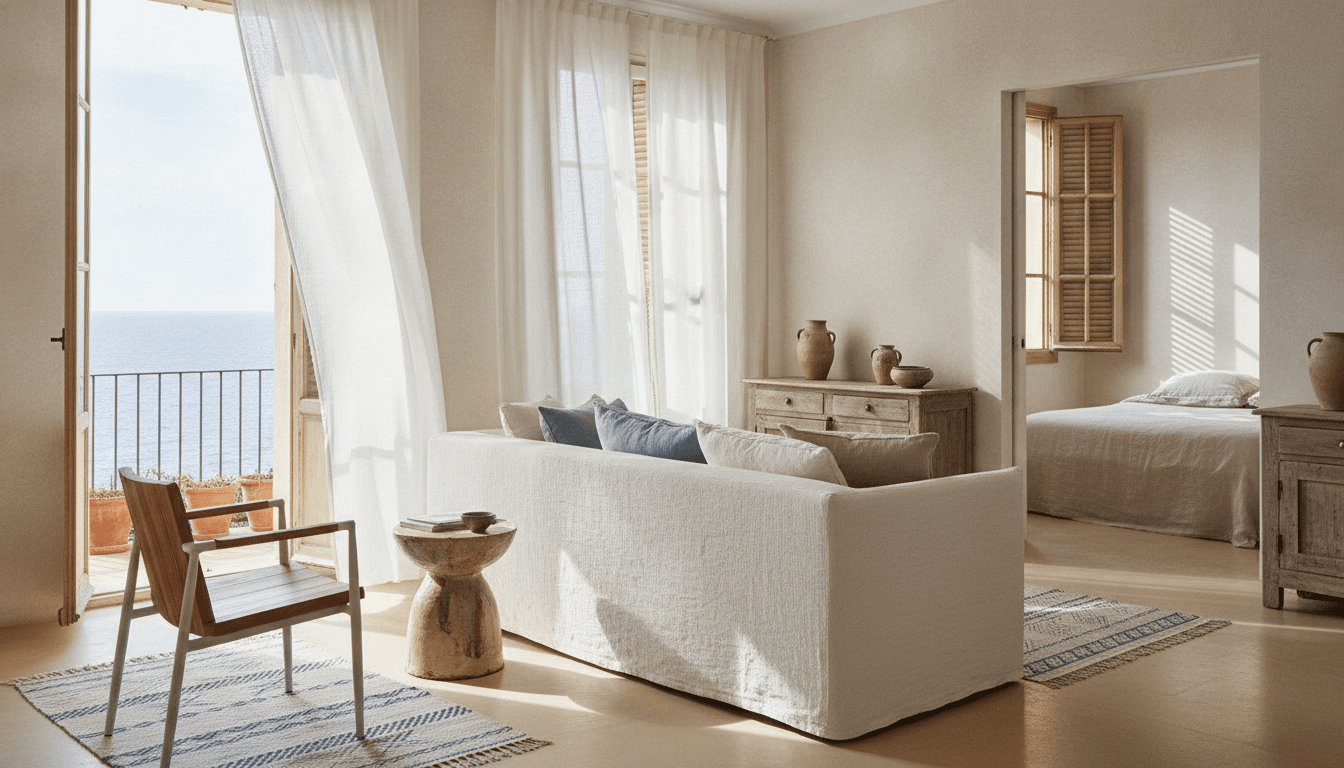
On the French Riviera, interiors wear out in very specific ways. Salt settles on surfaces, strong sun fades fabrics, humidity lingers when a flat stays closed, and in short-lets the guest turnover adds another layer of stress. If you are choosing coastal decor materials, the question is not what looks appropriate by the sea for one season. It is what will still feel clean, stable and easy to live with after repeated exposure to light, air and use.
Why homes by the French Riviera age differently indoors
People often expect the main problems to be outside on the terrace. In reality, the damage usually shows up indoors first. Curtain edges bleach near sliding doors. Veneers lift in rooms that stay shut for weeks. Cushions absorb moisture. Metal details lose their finish. In a compact apartment with a lot of glazing, all of this happens faster.
That is why I start with climate and use before I think about style. At Marea Studio, this is part of the work I do in full decoration, turnkey furnishing and home staging: I look at how the property is actually lived in on this stretch of coast, from Roquebrune-Cap-Martin to Menton, Monaco and Nice.
I usually assess four things first: how harsh the sun is, how close the sea-facing openings are, how long the property sits empty, and how realistic the maintenance routine will be.
Coastal decor materials for floors, walls and everyday surfaces
The best interior surfaces near the sea are usually the ones that cope well with fine sand, repeated cleaning and fluctuating humidity without asking for too much attention.
Floors that make sense in coastal homes
- Porcelain tile is one of the most reliable choices. It handles humidity well, is easy to mop, and works in understated stone, limewash or weathered-wood looks.
- Well-chosen luxury vinyl can be a practical option in a holiday rental, especially when sound, upkeep and easier replacement matter.
- Delicate timber floors need more caution near terraces and entry points. I am careful with them in properties that see irregular but intense use.
Wall finishes that are easier to live with
- Washable paint finishes in soft matte or low-sheen formulas are often more forgiving than very flat paint in busy coastal homes.
- Mineral decorative finishes can look very right on the Riviera, but only when they are used in sensible areas and not chosen as a purely visual gesture.
In home staging, this matters too. Fresh, coherent surfaces can help a property present better without building work. That is part of how I approach it: clear the visual noise, keep the materials believable for the location, and avoid finishes that already look tired before a buyer or tenant walks in.
Moisture-resistant fabrics: what I check before I specify anything
Textiles often fail quietly. They do not always look damaged at first, but they hold odours, dry slowly, fade unevenly or lose shape. In a sea-facing home, especially one with strong southern or western exposure, that catches up quickly.
For moisture-resistant fabrics, I keep the selection criteria simple: stable fibres, good abrasion behaviour, easy cleaning and colours that age gracefully in bright light.
- Indoor-outdoor performance fabrics are useful well beyond the terrace. I use them for dining chairs, bench seating, some headboards and cushions near open doors when the property needs to be robust.
- Pure linen can be beautiful, but it is not always the calmest choice in hard sunlight and humid rooms. I use it selectively.
- Blended fabrics often give a better balance of comfort, structure and maintenance.
- Heavy drapery is rarely my first choice by the sea. Lighter curtains, sometimes lined depending on orientation, tend to behave better.
For short-let properties, I also think about laundry cycles and reset time between guests. A fabric that looks good but is awkward to wash or slow to dry creates work very quickly.
Durable coastal furniture: materials that tolerate real life
Coastal furniture needs to survive both the setting and the habits that come with it. Beach bags get dropped on benches. Damp towels end up indoors. Chairs move in and out from a terrace. Windows stay open for hours. These are normal patterns, so the furniture has to absorb them calmly.
- Solid, well-finished wood is usually a safer route than fragile veneers that chip or lift at the edges.
- Powder-coated metal can work well for selected pieces and sheltered outdoor areas, provided the finish quality is good.
- Ceramic, glass and durable composite surfaces are useful on coffee tables, bedside tables and dining tops when you want easier upkeep.
- Natural fibres and cane need a measured hand close to the sea. I like the warmth they bring, but I do not overuse them in highly exposed homes.
At Marea Studio, I do not specify the same way for every client. A second home used quietly by its owners can allow for more delicacy. A furnished rental with frequent guest rotation needs durable coastal furniture that is easier to clean, steadier in use and less sensitive to accidental wear.
How to protect furniture from sea air before problems start
To protect furniture from sea air, the most effective decisions often happen before anything is delivered. Material matters, but proportion, detailing and placement matter as much.
- Keep very sun-sensitive pieces away from direct afternoon exposure.
- Choose low-porosity surfaces for dining and entrance areas.
- Prefer removable covers where possible.
- Be cautious with delicate metal handles and trims in humid rooms.
- Allow storage furniture to breathe if the property stays closed for long periods.
- Set up a simple between-stays routine: air out the rooms, wipe salt dust, check textiles.
This has become even more relevant for short-let owners on the French Riviera. With tighter local rules in some areas, many owners want interiors that are easier to maintain and less prone to small recurring damage. That is a sensible response to the reality of the market and the climate.
My way of choosing materials at Marea Studio
I do not believe in perfect material lists. By the sea, there is no single right answer. There are only better combinations for a specific property.
My job is to read the apartment honestly: the bright terrace connection, the closed shutters part of the year, the small footprint, the guest turnover, the strong Riviera light. Then I narrow the palette and remove weak points. That is how I approach decoration, turnkey furnishing and home staging at Marea Studio.
If I had to leave one useful takeaway, it would be this: choose by behaviour first, appearance second. If you want a clear framework for selecting materials, fabrics and furniture for a home on this coast, I explain my approach on the services page.