
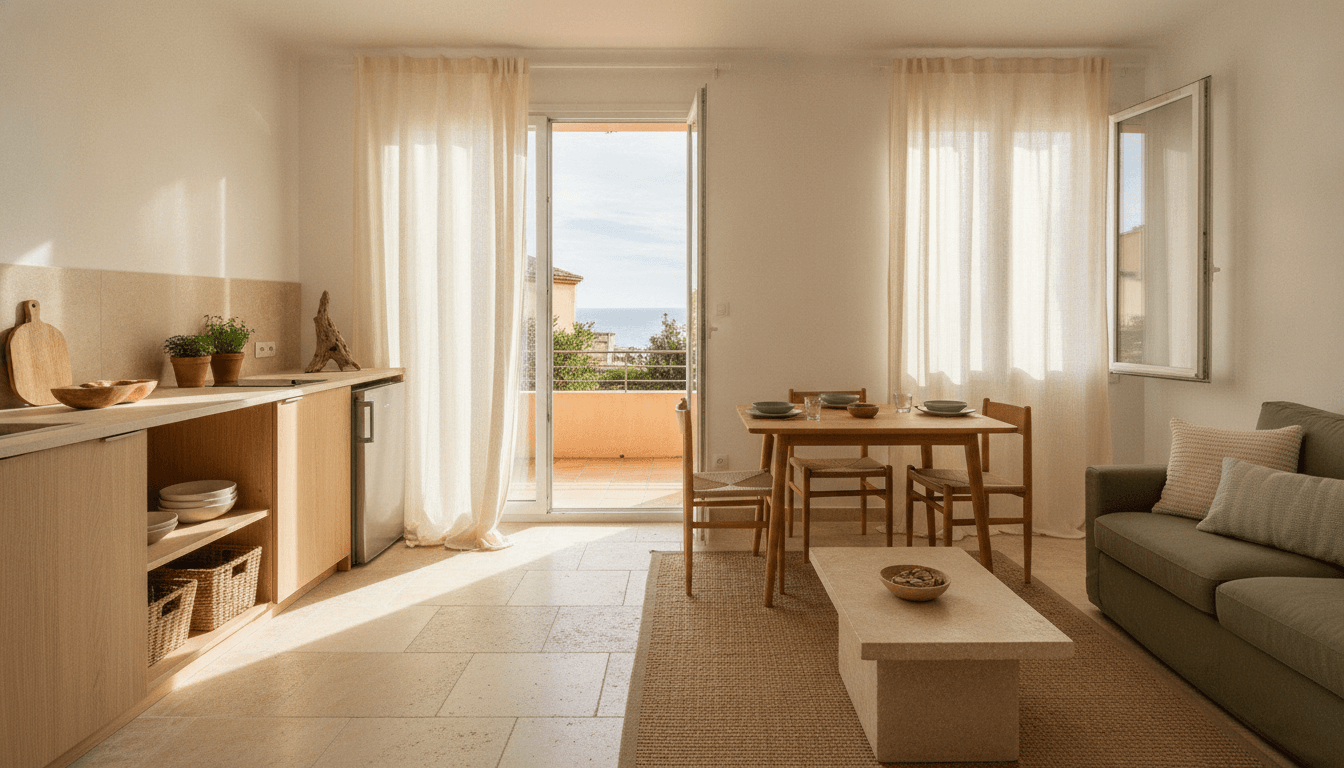
If you live in Italy and own a property on the French side, furnishing it for short lets can feel less straightforward than expected. On the French Riviera, the details matter quickly: bright light, salt air, terraces, compact flats, international guests and French furnished-rental rules. I wrote this guide to help owners make decisions in the right order, without mixing up legal equipment, comfort and decoration.
Start with French furnished-rental requirements, not with moodboards
Before choosing colours or furniture style, check what the property needs in order to qualify as a furnished rental in France. Decree 2015-981 sets out a core list of items, including proper bedding, cooking equipment, an oven or microwave, a fridge with suitable freezing capacity, crockery, kitchen utensils, a table, seating, storage, lighting, window coverings in bedrooms and cleaning equipment.
This matters early because a flat can look finished and still be incomplete under French rules. For Italian owners, that is often the first practical gap: what feels rental-ready at home may not be enough in France.
I usually suggest sorting everything into three groups:
- required for furnished-rental compliance,
- necessary for a comfortable stay,
- useful for presentation and photos.
That is also how I approach turnkey furnishing at Marea Studio. I separate compliance, guest use and visual presentation so the budget goes to the right places first.
On the French Riviera, the climate should shape your choices
A holiday flat in Menton or Roquebrune-Cap-Martin does not wear like a standard city apartment. The Riviera climate is pleasant, but it has consequences indoors.
Strong sun can fade fabrics. Salt air marks metal finishes. Sand and fine dust come in easily from terraces and beach days. Many properties are second homes or compact one-bedroom flats, which means storage is limited and cleaning needs to stay simple.
That leads to practical decisions:
- washable textiles that are easy to replace,
- durable finishes rather than delicate glossy surfaces,
- furniture with enough clearance to clean underneath quickly,
- solid dining chairs instead of purely decorative ones,
- a small but real arrival zone for keys, bags and beach items.
Terraces deserve special attention. Even a small outdoor space can carry a lot of value in a listing, but only if it is actually usable. In many cases, a proper outdoor table and two comfortable chairs will do more for the guest experience than a crowded decorative setup.
How to furnish a holiday home for an international guest mix
One cross-border issue many Italian owners underestimate is guest variety. On the French Riviera, the audience is rarely one-type-only. You may host couples, families, remote workers, weekend visitors, guests arriving by train, and summer travellers coming with beach gear.
So the flat needs to read clearly from the first few minutes. When I work on interior decoration or turnkey furnishing for short lets, I focus on immediate usability: where a suitcase goes, where phones charge, where towels dry, where breakfast happens, where two people can sit comfortably without blocking circulation.
The basics guests notice most are simple:
- good blackout in sleeping areas,
- easy evening lighting,
- bedding that matches the positioning of the property,
- a compact kitchen that is still complete,
- enough storage not to live out of a suitcase,
- a calm interior language that fits the coast.
A Mediterranean direction works well here when it stays restrained: light wood, limestone tones, linen, cotton, woven textures, muted greens and soft sea blues. I would avoid theme decor. Guests usually respond better to a place that feels settled and practical than to something designed around obvious holiday clichés.
Check building rules and rental admin before buying too much
Furniture decisions often come too early. Before ordering, make sure short-term tourist rental use is compatible with the building rules. In France, some co-ownership regulations can restrict this type of activity, especially in certain buildings with stricter residential clauses. That point needs checking first, particularly if you are managing the purchase from Italy.
There are also registration and tax-related steps linked to French short lets, including SIRET registration and local obligations that have changed in recent years. Those steps are outside my role as a decorator, but they affect the furnishing brief. I always raise them early with owners because the intended use of the property should shape what goes into it.
If the property may be classified as a furnished tourist rental, equipment choices and overall presentation may need even more care. The sequence matters: confirm the framework, build the equipment list, then decorate.
How to spend without over-furnishing
The most common mistake is spending too much on visible styling and not enough on everyday function. Owners buy wall decor and small accessories, then realise the flat still lacks blackout curtains, bedside lighting, a proper dining table, comfortable chairs or useful storage.
My approach is to prioritise the pieces that affect both daily use and listing photos:
- the bed setup,
- dining table and seating,
- window treatments,
- lighting,
- kitchen equipment,
- outdoor furniture if the terrace is part of the appeal.
Only after that do I add decorative layers such as a washable rug, a mirror, a few cushions, ceramics or framed pieces. In small Riviera properties, restraint usually photographs better and stays easier to manage between bookings.
Owners generally have three routes: handle everything themselves, buy a standard furnishing pack, or work with a local studio. Doing it yourself gives control but takes time on site. Packs are fast but often generic. Marea Studio sits in the third category, and I say that with an obvious bias: I help with decoration, turnkey furnishing and rental-focused home staging, always without building work, and always with close attention to the local setting. If that context is useful, my service page is here: /en/services.
The real goal is a flat that is easy to use, easy to maintain and easy to present well
The best holiday rental interiors on the French Riviera are not the fullest or the most styled. They are the ones that respect French requirements, handle the local climate and make sense to guests who arrive tired, with luggage, and need the place to work immediately.
If I had to leave one takeaway, it would be this: start with compliance and use, then let decoration support the atmosphere. That order prevents most expensive mistakes.