
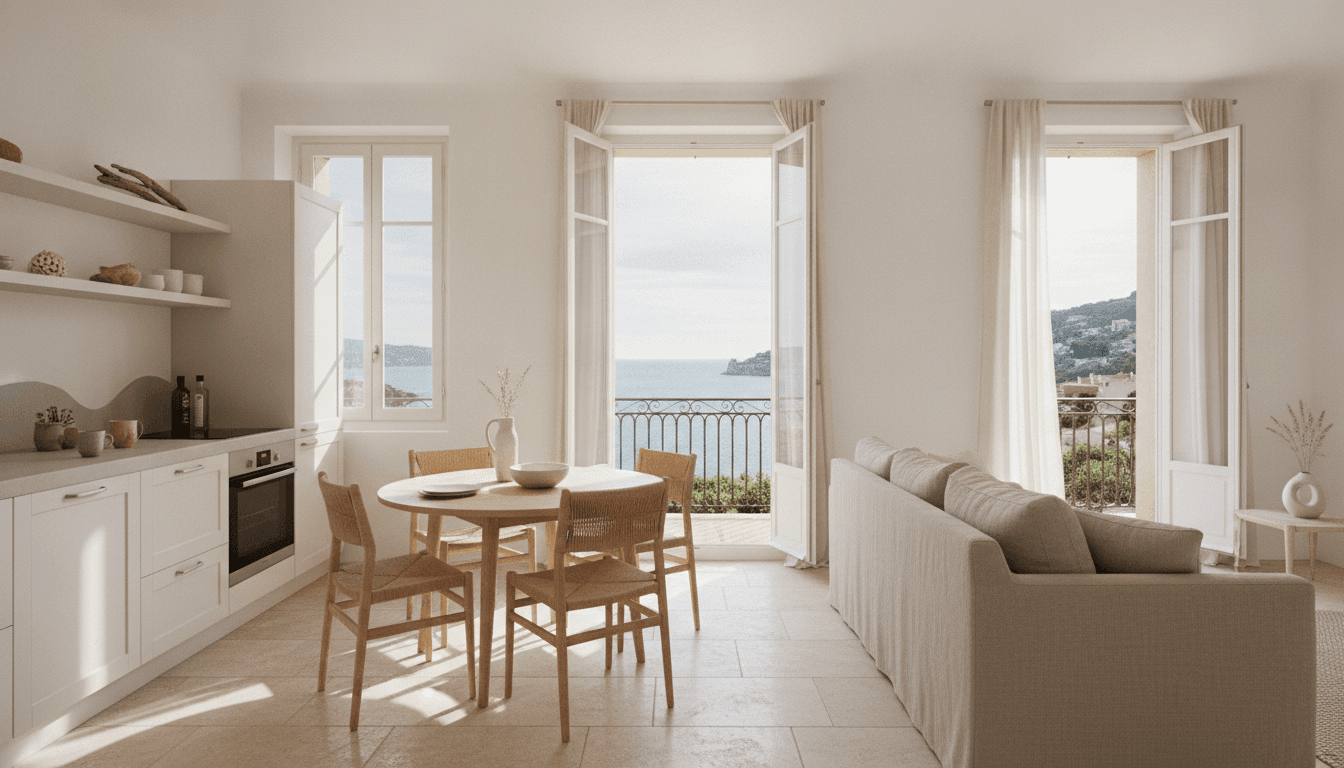
If your property is not landing as it should, the question comes quickly: home staging or renovation before selling? On the French Riviera, buyers are demanding, listings are compared side by side, and many people want a place that already feels easy to live in. That does not mean you need major works. Very often, you need a clearer presentation, not a full rebuild.
Home staging or renovation before selling starts with the right diagnosis
I find that owners often jump too fast from “this looks dated” to “we need works”. Those are not the same thing. A flat can feel old-fashioned in photos and still be perfectly sellable once the layout is clarified, the light is improved, and the distracting details are removed.
On the French Riviera, I see the same patterns again and again: heavy curtains blocking daylight, too much furniture in small rooms, terraces used as storage, salt-worn finishes near the sea, second homes left half-equipped, kitchens that are visually tired but still functional. Not all of that calls for renovation.
Home staging is about making the property readable. Renovation is about changing or rebuilding parts of it. If the main issue is first impression, circulation, light, scale, or visual noise, staging is usually the more sensible place to start.
At Marea Studio, this is the work I do when I help prepare a property for sale: I look at it as a buyer will see it online and then in person, and I separate what truly blocks confidence from what simply needs editing and better presentation.
When renovation before selling can still make sense
I do not do building work, renovation management, or architecture. So my bias is simple and open: I first look for solutions without major works. Still, it would be misleading to say renovation is never worth considering.
There are situations where targeted work may be reasonable:
- active damp or clear waterproofing issues
- electrical or gas concerns that create hesitation during viewings
- windows or shutters badly damaged by sun, wind, or salt air
- a property where energy-related compliance has become a real question for the next owner or landlord
That is not about style. It is about trust. If a technical issue is visible, documented, or likely to become the centre of every conversation, it deserves proper attention from the right trade professional.
What I would question more carefully is the impulse to replace a usable kitchen, redo a whole bathroom because it feels unfashionable, or modernise everything before the property goes on the market. Many buyers, especially in second-home locations, would rather choose those finishes themselves.
Home staging or renovation before selling: the decision filter I recommend
If you are comparing home staging or renovation before selling, I suggest using a simple filter rather than reacting room by room.
Does the problem show up strongly in photos?
If the answer is yes, staging is often the first move. Poor lighting, overfull shelves, bulky furniture, mismatched textiles, a bare terrace, and awkward room use all affect the listing before anyone books a viewing.
Does it affect daily use?
A door that does not close properly, weak lighting in a bathroom, or poor ventilation can often be corrected with light intervention. That is very different from opening a full site.
Does it undermine trust?
Persistent humidity smells, damaged surfaces in sensitive areas, visible mould traces, or technical documents likely to worry buyers move the discussion into another category.
Would the next owner redo it anyway?
In parts of Nice, Monaco, Menton, and Roquebrune-Cap-Martin, some buyers already assume they will personalise the property after purchase. In that case, the most useful step is often to present the space cleanly and honestly, not to pre-empt their taste with expensive choices.
What I would improve first on the French Riviera without major works
There is a middle ground between doing nothing and renovating everything. For many sellers, that is the most practical route.
- Light first: remove heavy window treatments, review lamp temperature, and let the Riviera daylight do its work.
- Terraces matter: even a small outdoor space should read as usable, not neglected. A chair, a table, and a clear function are often enough.
- Define compact rooms: many coastal flats have modest footprints. Buyers need to understand immediately where to eat, work, sleep, and store things.
- Reduce signs of seaside wear: faded fabrics, oxidised metal, tired white paint, and warped accessories make a property feel less cared for than it may actually be.
- Depersonalise with restraint: remove the excess, but do not make the flat feel vacant and cold if it is occupied.
A vacant property and an occupied one need different handling. In an empty flat, I focus on scale and function so rooms do not feel smaller or harder to read than they are. In a lived-in home, I focus on editing and visual order.
At Marea Studio, I also offer turnkey furnishing. That is useful when a property needs a clean, neutral setup for sale or when an owner is preparing a furnished asset for the short-let market after purchase. The point is not decoration for decoration’s sake. It is to make the space understandable and ready to be seen properly.
How I would compare the options honestly
If the issue is structural or technical, speak to the appropriate trade or contractor. If the issue is pricing strategy or market positioning, the estate agent has an important role. If the issue is how the property reads in photos and visits, that is where I come in.
My work at Marea Studio sits on the presentation side: home staging, interior decoration, and turnkey furnishing. I am openly biased toward light-touch changes when major works are not necessary, because many sale problems come from confusion, not from the building itself.
This matters on the French Riviera. Strong light reveals clutter quickly. Humidity and salt air age finishes in uneven ways. Outdoor areas carry real emotional weight. And in second homes or short-let properties, buyers often make fast judgments about ease, upkeep, and immediate usability.
The real calculation
The real calculation is not only about money. It is also about time, delay, uncertainty, and the risk of making choices your buyer may not value.
In many cases, the better question is not “should I renovate?” but “what exactly is stopping this property from being clearly understood?” If the answer is visual, spatial, or atmospheric, home staging is often the more proportionate response.
My honest takeaway is simple: before opening a renovation project, check whether your property mainly has a presentation problem. If it does, that is the kind of work I do at Marea Studio through home staging, decoration, and turnkey furnishing. You can read my approach on the services page.