
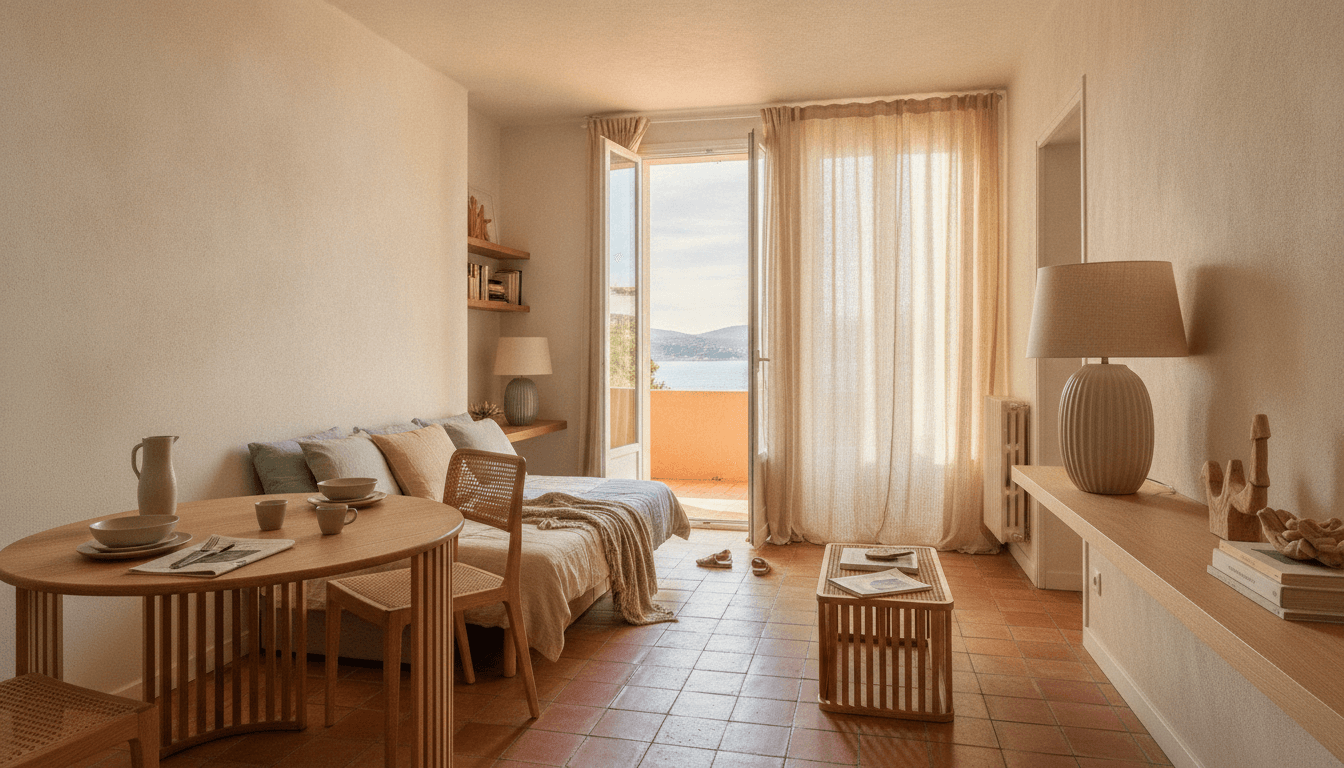
If you own a second home in Menton, the easiest furnishing mistake is also the most common one: bringing whatever is available from elsewhere and hoping it will do for now. A spare table, an old sofa, mismatched chairs, a bed that was fine in another flat. On paper that feels economical. In a small seaside apartment, it often creates clutter, awkward circulation and an interior that never settles.
On the French Riviera, second homes have very specific conditions. They may sit closed for stretches of time, then be used intensively on weekends or holidays. They deal with humidity, salt air, sandy shoes, terrace doors opening all day, and in some cases short-let turnover. The furnishing needs to answer that reality.
Why leftover furniture works badly in Menton flats
The issue is not budget. The issue is fit.
Many flats in Menton are modest in footprint, and that changes everything. A dining table that is slightly too deep can make the room feel blocked. A dark wardrobe can absorb the light. A bulky armchair can turn a useful corner into dead space. When pieces arrive one by one, with no overall plan, the apartment starts behaving like a storage unit rather than a second home.
I would pay attention to four warning signs:
- you have to sidestep around furniture to move through the room;
- there is nowhere obvious to put luggage, cleaning supplies or beach things;
- seating and sleeping are solving the same problem badly;
- the flat looks temporary, even after you have spent money on it.
That last point matters. A second home should feel ready when you arrive, not as if it is still waiting to be finished.
Furnishing a seaside home starts with use, not style
People often begin with mood boards. I think a better starting point is a very plain list of uses. How many people sleep there regularly. Do you eat indoors every evening or mostly on the terrace. Do guests stay over. Do you need a proper work spot for a laptop. Will the flat also be offered as a furnished holiday let.
Once those answers are clear, decisions become easier. In a studio, a fixed bed may be worth more than a large sofa. In a one-bedroom flat, a compact round table may work better than a rectangular one because circulation matters more than formal dining. Closed storage can be more valuable than decorative shelving because it keeps the visual field calm.
This is the approach I take at Marea Studio when I handle full decoration or turnkey furnishing. I do not begin by filling rooms. I begin by deciding what the room has to do, then I choose the minimum amount of furniture needed for that use to feel comfortable.
What deserves priority
- Reliable sleeping with the best mattress and bed format the plan can support.
- A table that earns its place for meals, work and everyday use.
- Closed storage for the things that otherwise end up permanently visible.
- Moveable seating that can shift between daily life and guests.
- Layered lighting so the flat feels calm in the evening, not overlit.
Materials matter more by the sea
In Menton, the light is generous and the sea is close. That combination is beautiful, but it can also be unforgiving. Salt air settles on surfaces. Humidity lingers. Fabrics need washing. Floors need easy maintenance. Terrace life means dust and sand come in more often than owners expect.
For that reason, I usually lean toward practical materials with a soft feel: washable cotton, linen blends, well-finished pale timber, treated metal, ceramics, flatweave rugs, simple curtains that filter light without making the room heavy. I would be careful with anything too delicate, too glossy or too precious for an apartment that is opened and closed throughout the year.
The coastal look itself also benefits from restraint. On the French Riviera, a good seaside interior rarely needs obvious nautical references. Sand, chalk, faded blue, pale green and warm off-white do the work quietly. Natural texture does more than themed décor ever will.
A seaside apartment usually feels better when it suggests the coast through light, materials and ease of use, rather than through decorative clichés.
If you may rent it out, furnish for clarity
Some owners use their Menton flat privately and also consider short lets for part of the year. In that case, the apartment needs to be easy to understand the moment someone walks in. Guests should immediately see where coats go, where suitcases can sit, where breakfast happens and where towels dry.
Local rules and administrative requirements are a separate matter and deserve careful checking. What the interior can do, however, is reduce friction. A compact kitchen can still feel complete if every essential item has a clear place. A small bathroom becomes easier to maintain when surfaces stay mostly free. A bedroom or sleeping area works better when charging points, bedside lighting and storage all feel obvious.
When I work on these properties through Marea Studio, I am not providing renovation, building work or architecture. My role is furnishing and decoration within the existing shell: planning the layout, selecting pieces, choosing textiles and lighting, then setting everything up in a coherent way if the owner wants a turnkey result.
A simple method if you are buying and furnishing from Italy
The biggest distance-related mistake is shopping in fragments. One trip produces a sofa. The next produces bedside tables. Later someone adds a rug and a spare chest of drawers. The apartment ends up full of decisions that made sense separately but not together.
A more reliable order is this:
- keep only the pieces that genuinely deserve to stay;
- measure walls, door clearances, window positions and circulation paths properly;
- build a room-by-room list based on function, not impulse;
- limit the palette of materials and colours early;
- choose with cleaning, durability and future replacement in mind.
That also means being honest about inherited or leftover furniture. One well-scaled older piece can add depth. Several pieces kept out of guilt usually cost more in space than they give back in value.
My honest view as a decorator in this area
I work with exactly these questions at Marea Studio: second homes that need full decoration, apartments that need turnkey furnishing, and properties that need home staging before sale or rental. My bias is simple and I state it openly. I prefer rooms that are measured, calm and useful over rooms that are merely full.
If you are comparing options, doing it yourself can work when you have time on the ground and a clear eye for scale. A large furniture retailer can solve supply, but not always coherence. A studio like mine adds planning and editing, though of course I say that as the founder. If that comparison is useful, I explain my scope clearly on the services page.
The most useful takeaway is this: in a small second home by the sea, restraint is practical. Fewer, better-chosen pieces usually make the flat easier to live in, easier to maintain and easier to return to every time you arrive.