
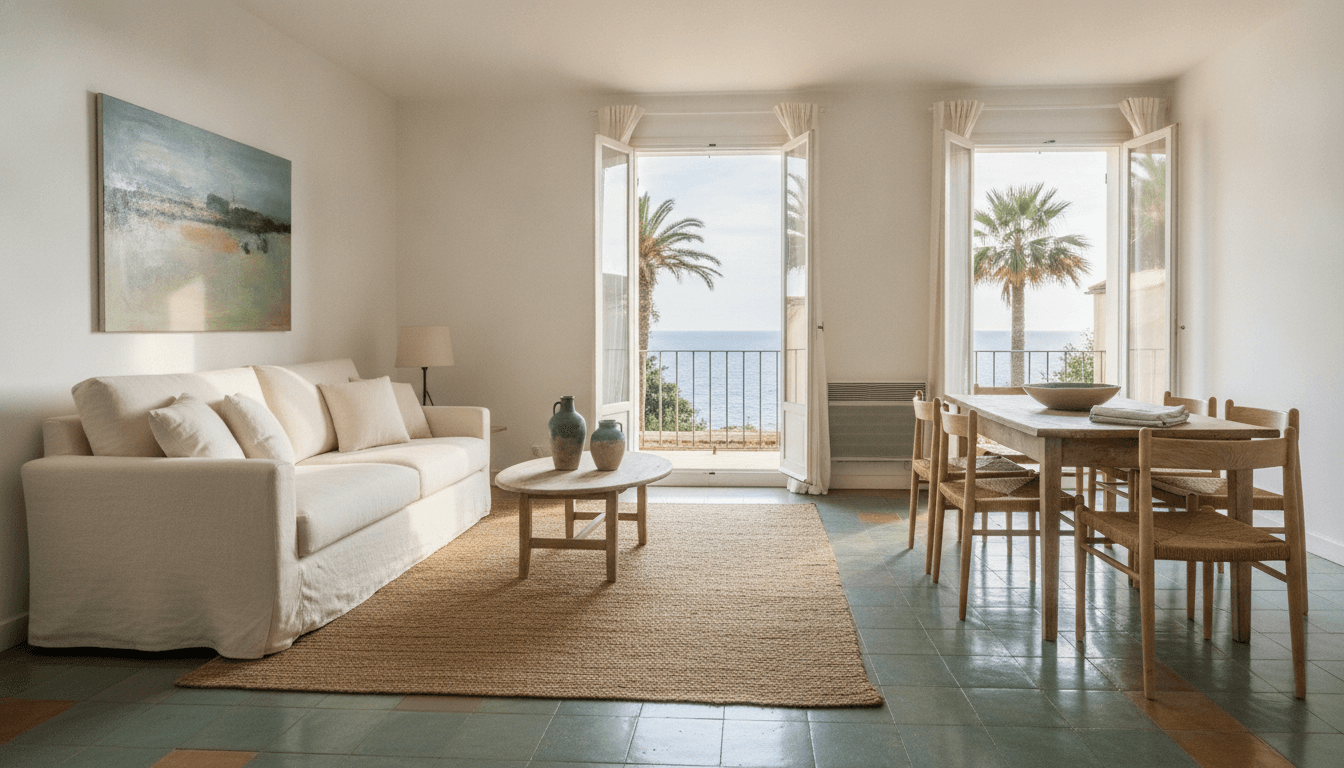
If you are trying to decide whether to sell an apartment empty or furnished on the French Riviera, the answer is rarely absolute. An empty place can look smaller and harder to read. A furnished place can help buyers picture life there, but only if the furniture supports the space instead of fighting it.
Most owners are really choosing between three options: leave it empty, sell it furnished, or stage only the parts that need help. In my work at Marea Studio, that third option often makes the most sense for vacant Riviera stock.
Sell an apartment empty or furnished: the real question is readability
Online, this debate usually turns into opinions. Some people say empty homes feel cleaner and let buyers imagine their own style. Others say furnished listings get more attention because they feel easier to understand. Both can be true.
On the French Riviera, buyers often start with photos from afar. Many are comparing second homes, pieds-à-terre, or short-let investments from another city or another country. They want to understand the layout quickly: where the table fits, whether the bedroom takes a proper bed, whether the terrace feels usable, whether the living room is actually narrow.
That is why I look first at visual clarity. If a room is easy to read and already has strong assets such as a view, good proportions, or generous light, empty may be fine. If the plan is awkward, compact, or emotionally flat, furnishing can help. My job at Marea Studio is to make that call honestly, using home staging, interior decoration, or turnkey furnishing depending on the situation.
When an empty apartment works against the sale
There are cases where an empty apartment tends to underperform. Small one-beds, studios, split-level layouts, narrow living rooms, dark entrances, and oddly shaped bedrooms often need scale markers. Without them, buyers guess wrong.
This is especially common on the French Riviera, where many apartments have small footprints but strong outdoor value. A compact interior with a lovely terrace can be a very good property, yet if the inside is totally bare, the listing may feel colder than the actual lifestyle it offers.
Empty also exposes every weak point at once. Old tile, awkward sockets, a short wall, an in-between corner, a low ceiling line. Since Marea Studio does not do renovation, building work, or architecture, I approach these properties through presentation only: layout, proportion, light, textiles, and the minimum amount of furniture needed to explain the room.
In practical terms, an empty apartment often struggles when:
- the room sizes are hard to judge from photos
- the property was previously used as a short-let and now feels abruptly stripped
- the terrace matters a lot but is not set up to show how it can be used
- the apartment is a second home that has been closed for part of the year and feels flat in person
When furnishing helps, and when it makes things worse
To sell an apartment empty or furnished, you need to think about the likely buyer. On the French Riviera, some want a blank canvas. Others want a place they can use quickly, especially if they live abroad, visit seasonally, or plan to let the property furnished later.
Furnishing helps when it answers practical questions. A light sofa shows the real width of the sitting room. A dining table proves that meals fit comfortably. A bed with scaled bedside tables stops a bedroom from feeling like a corridor. A small outdoor set can make a terrace feel like a real extension of the apartment instead of leftover square metres.
But furnishing can also hurt. I see this often with inherited pieces, bulky holiday-rental furniture, dark wood, heavy curtains, too many small accessories, or mismatched chairs collected over time. In Riviera light, clutter shows immediately. Salt air and humidity also age certain fabrics and finishes fast, so tired furniture looks even more tired here.
At Marea Studio, when I furnish for a sale, I keep it restrained. I am not trying to create a fantasy interior. I am trying to make the apartment legible, calm, and believable. If the owner plans to include the furniture in the sale, I also remind them that the legal side matters: a precise inventory of the included furniture should be attached to the sale documents.
The strongest middle ground: partial staging for vacant stock
In many cases, the best answer is partial staging rather than full furnishing.
This means selecting only the zones that need support: the entrance, living room, main bedroom, dining area, and sometimes the terrace. You do not need to furnish every corner. You need to remove hesitation from the buyer’s mind.
On the French Riviera, this approach works well because the environment is visually demanding. Sunlight is sharp. Outdoor-indoor living matters. Apartments are often compact. Materials need to look right in bright conditions. A sparse but thoughtful setup reads better than either total emptiness or over-decorating.
A vacant apartment home staging scheme might include a rug with low pile, a sofa on legs, simple linen curtains, clear bedding, one dining setup, a few lamps, and limited styling. Enough to show scale and mood, not so much that buyers start judging your taste instead of the property.
This is one of the situations I handle most clearly at Marea Studio: a vacant apartment that does not need construction work, but does need help being understood.
Things to check before deciding to sell furnished
Before you decide to sell furnished, there are practical questions beyond presentation.
If furniture is included in the sale, it should be listed accurately in an inventory attached to the legal documents. Some sellers also ask about separating furniture value in the paperwork because transfer duties do not apply to the declared furniture value in the same way. That conversation belongs with the notary, especially if supporting invoices are needed.
Another local point matters on the French Riviera: many furnished properties have been used as seasonal lets or under furnished-rental tax regimes. If that applies to you, the tax implications can affect the decision to sell furnished or not. I prefer to be direct here. This is where a notary or accountant should advise, not a decorator.
My part starts after that: what to keep, what to remove, what to stage, and whether turnkey furnishing is worth doing for the sale itself.
My simple decision framework
If you want a practical way to decide, this is the framework I use.
- Sell empty if the apartment already reads well, has generous proportions, or a strong view does most of the work.
- Sell furnished if the likely buyer values immediate usability or the rooms are hard to read without scale.
- Choose partial home staging if the property is vacant and decent, but emotionally flat or visually confusing.
- Remove existing furniture if it blocks light, shrinks the rooms, or feels tied to an outdated rental setup.
- Stage the terrace whenever outdoor living is part of the appeal, which is often the case here.
If you compare providers, estate agents can give market-facing advice, furniture-rental companies can supply stock, and studios like Marea Studio bring a presentation-led view. My bias is clear: I look first at how the property is read by a buyer, then I recommend either home staging, decoration, or turnkey furnishing in the smallest effective dose.
My honest takeaway is this. On the French Riviera, the best choice is rarely empty versus furnished in principle. It is the version that makes the apartment easiest to understand for the buyer you are likely to attract. If that is useful, I explain my service approach here: /en/services.