
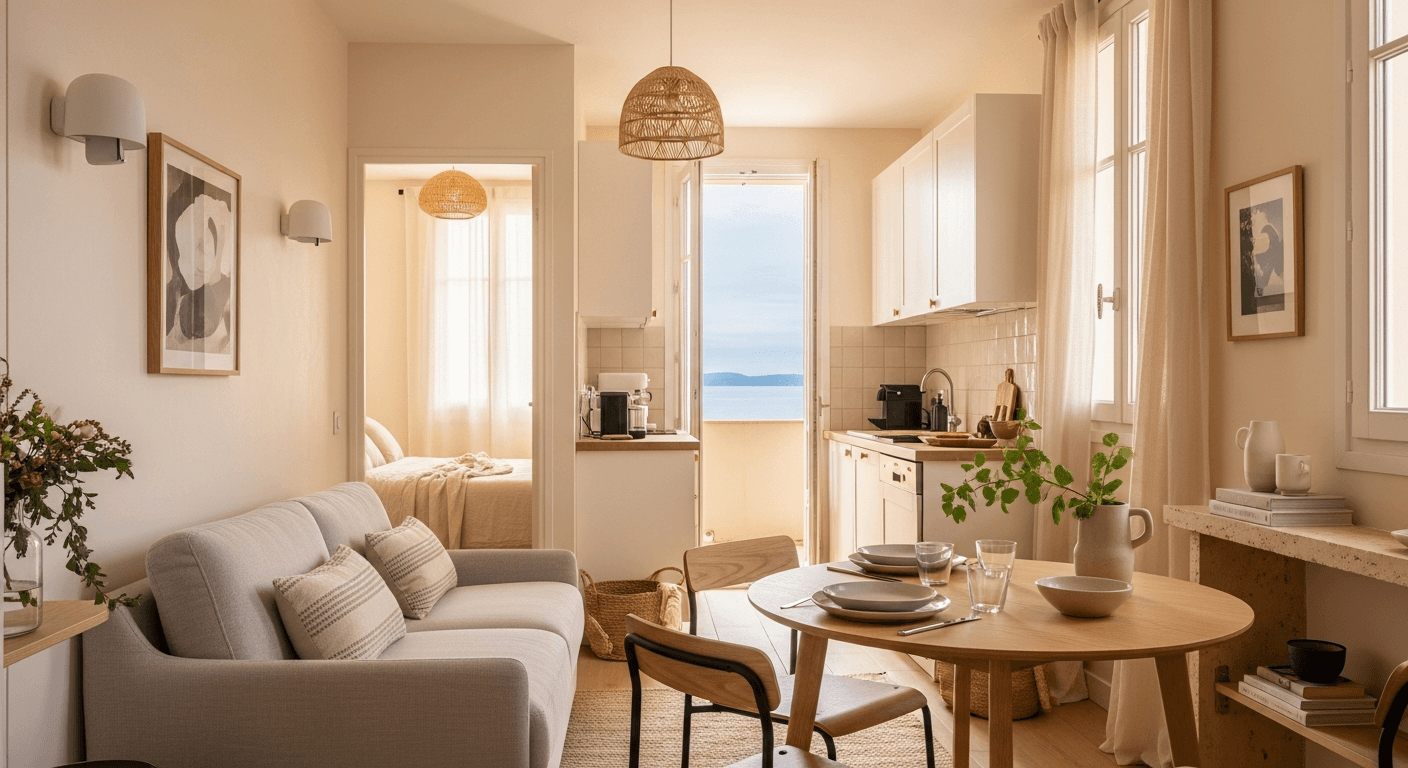
The difficult part of setting up a short-let is rarely choosing a colour palette. It is working out what you actually need to spend, room by room, before the apartment starts to feel either underfurnished or wasteful. If you are searching for a short-let furnishing budget, most advice stays vague. I prefer a clearer framework, especially for small apartments on the French Riviera.
Short-let furnishing budget: start with a workable range
Owners usually want a straight answer first, so it helps to begin with broad market ranges often seen in full-furnishing quotes. For a standard one-bedroom apartment, a common working range is around €3k to €8k. For a more polished one-bedroom setup, often closer to what Riviera guests expect in a good location, a typical range is around €4k to €5.5k. For a two-bedroom apartment, many furnishing plans land around €8k to €15k.
That does not mean every apartment should spend at those levels. It means those figures are useful starting points.
On the French Riviera, cost depends quickly on the real footprint of the property, how many people you intend to host, and how much the apartment has to do. A compact flat in Roquebrune-Cap-Martin used for weekend stays will not need the same setup as a family-focused summer rental in Nice.
Local conditions matter too. Bright southern light shows every material choice. Salt air and humidity are hard on metals, fabrics and outdoor furniture. Small terraces often deserve part of the budget, but not too much of it.
Short-let furnishing budget by room: where the money usually goes
One of the easiest ways to avoid overspending on styling and underspending on use is to split the budget by area. A simple allocation can look like this:
- bedroom: about 30%
- living room: about 25%
- kitchen and dining: about 20%
- linen: about 10%
- entrance, bathroom, lighting, accessories and buffer: the rest
The bedroom takes a large share for a reason. In short-let reviews, sleep comfort is felt immediately, even if guests never describe it in technical terms. A proper bed, stable bedside tables, blackout where needed and straightforward storage usually matter more than decorative extras.
The living room comes next because it tends to carry the listing photos. For Riviera apartments, I usually keep this room calm and legible. A decent sofa, a coffee table that can survive turnovers, a compact dining setup and a few well-placed lamps go further than too many decorative pieces.
The kitchen does not have to be expensive, but it needs to feel complete. Missing basics, fragile glasses, pans that wear out too fast or poor storage all make a property feel improvised.
At Marea Studio, this is exactly the work I do when I put together a turnkey furnishing plan for a short-let: I go through the apartment room by room, check that sleeping, dining, storage and linen turnover are properly covered first, and only then decide what visual elements the space actually needs.
Short-let furnishing budget for a one-bedroom apartment
If I am planning a one-bedroom flat, I usually build the budget around real use rather than headline furniture items:
- get the main bed right first
- make the living area easy to photograph and easy to use
- keep the dining area compact, but comfortable enough for actual meals
- allow for duplicate linen sets to make changeovers easier
- treat the terrace as a bonus space, even if it is small
This is often the point where people asking how much it costs to furnish a one-bedroom stop looking for a single magic figure. The better question is what each room needs to do.
Before style, there is the required furnishing list
Before comparing quote levels, it is worth checking the legal baseline. In France, Decree No. 2015-981 of 31 July 2015 sets out the mandatory furnishing list for a furnished rental. That list matters for short lets too.
In practical terms, the property needs the essentials for sleeping, eating, cooking, storage, lighting and household upkeep, with suitable window covering in rooms intended for sleep. Missing even one required item can create problems.
When I map a furnishing budget, I find it helpful to separate three layers:
- mandatory, meaning what the furnished status requires
- functional, meaning what makes a short stay easy
- visual, meaning what improves photos and overall coherence
That order matters. Many apartments spend too early on the third layer.
On the French Riviera, I also pay attention to things that become obvious during guest turnover: where beach towels dry, where suitcases land, whether the entrance has hooks, and whether the apartment can darken properly after a late evening outside.
Studio, one-bed, two-bed: how the budget shifts with the layout
A studio has to work harder per square metre. I usually prefer fewer elements, chosen carefully: a comfortable sleep setup, a table that earns its place, lightweight seating and storage that keeps the room readable. In bright coastal interiors, clutter looks bigger than it is.
In a one-bedroom apartment, the main tension is often between extra sleeping capacity and a pleasant living room. It is tempting to add too many solutions for occupancy. In many cases, a calmer, more usable lounge gives a better overall impression, especially if there is a terrace or open view.
With a two-bedroom apartment, the budget rises because functions repeat. More beds, more side tables, more linen, more crockery, more lighting. Owners often think first about the large furniture pieces, but the smaller repeated items add up quickly.
On the Riviera, outdoor space should be treated as a secondary room. A simple table and a pair of sturdy chairs may be enough. The aim is not to overfurnish the terrace. It is to make it usable in morning light or after the beach.
The lines people often forget: linen, durability and replacement logic
Linen often represents around 10% of the total furnishing budget, and I would not treat it as an afterthought. Sheets, mattress protectors, pillows, towels, bath mats and kitchen textiles need to be planned as full sets, not isolated purchases.
I also suggest choosing finishes that forgive repeated use. Hard-to-clean upholstery, delicate table surfaces, thick rugs, lightweight chairs and metals that react badly to salt air tend to age poorly in holiday rentals on the coast.
Some common mistakes are very simple:
- buying undersized furniture to keep the room visually light
- mixing too many styles and losing clarity in photos
- forgetting secondary lighting
- leaving too little practical storage
- spending on accessories before linen and core equipment
From a management point of view, furniture is also something many owners think about over time. A common planning logic is to consider furniture amortised over 12 to 24 months. That is not a universal rule, but it is a useful reminder that the right purchase is not just the one that looks good when delivered. It is the one that still works after repeated stays.
The most useful answer is a clear budget, not a seductive estimate
In the end, building a short-let furnishing budget is mostly about priorities. Start with what furnished status requires, then fund daily comfort, then improve the look of the listing. For a studio, one-bedroom or two-bedroom apartment on the French Riviera, that approach is usually more useful than a glossy estimate with missing lines.
If I had to leave one practical takeaway, it would be this: budget room by room, add a separate line for linen, add another for outdoor furniture, and keep a margin for the items everyone forgets the first time.
If you want to turn that framework into an actual apartment setup, I explain on /en/services how I work at Marea Studio across home staging, full decoration and turnkey furnishing. The point is not to add more items, but to make each one answer a real use in the property.