
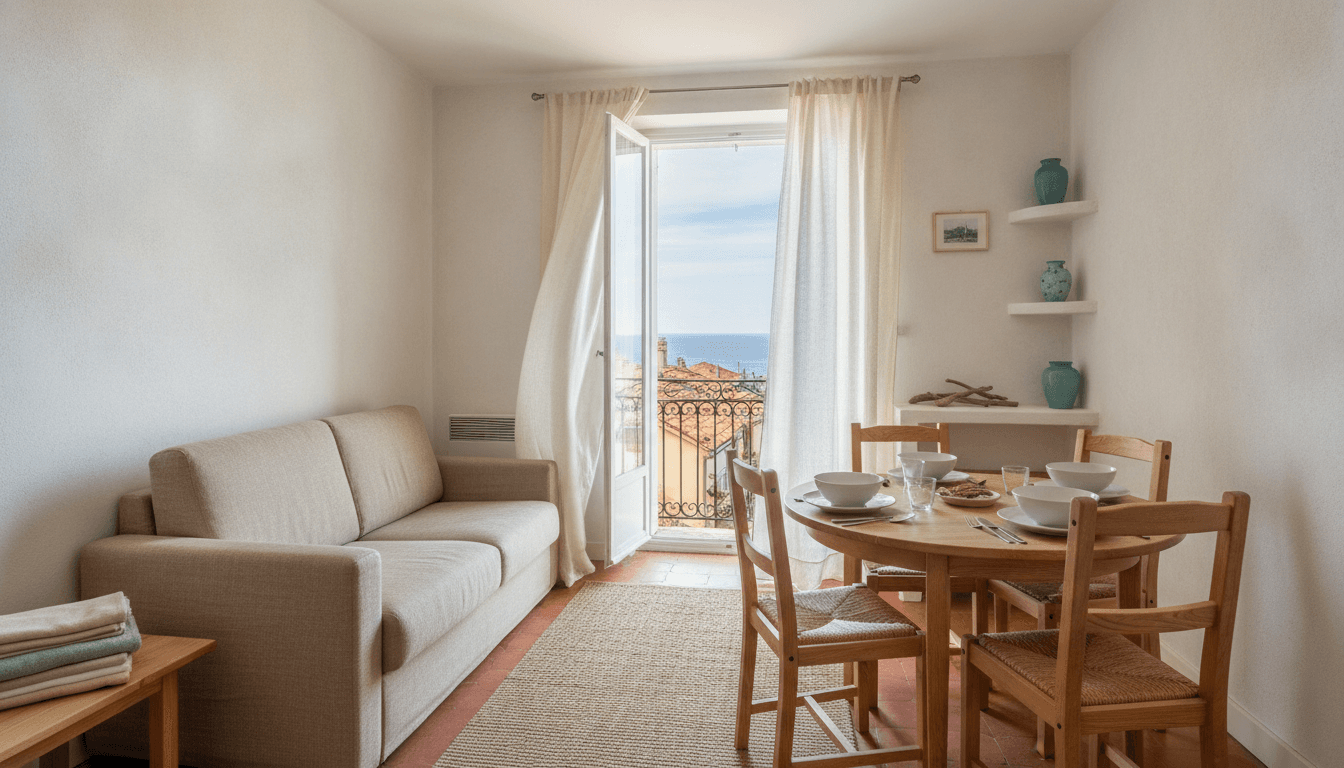
Many Italian owners are now looking across the border with the same question: can I still run a short-term rental in France in a straightforward way in 2026. The answer is yes in some cases, but only if you check the legal frame first. On the French Riviera, the order matters: building rules, co-ownership rules, registration, energy requirements, then furnishing.
I run Marea Studio in Roquebrune-Cap-Martin. I do not handle building work, renovation or architecture. My work is home staging, full interior decoration and turnkey furnishing. For a short-let, that means a home that is clear to use, durable in a coastal climate and ready to be presented properly.
Short-term rentals in France now start with permission, not décor
If you own, or plan to buy, in Menton, Nice, Roquebrune-Cap-Martin or Cannes, start with a very plain check: is short-term letting allowed in the building, and what does the local authority require.
Co-ownership rules matter more than many buyers expect. Following changes associated with Loi Le Meur, apartment buildings can now move more easily to restrict short-term rentals, with a two-thirds majority commonly cited in professional summaries of the new rule. For an Italian buyer, that makes the building regulations essential reading before purchase, not after.
Then come the city rules. They are not interchangeable.
- Nice has reinforced controls in certain areas, with quotas and temporary change-of-use authorisation for some second homes.
- Cannes requires a declaration and registration number for all meublés de tourisme, including a first property.
- Menton attracts cross-border owners, but local procedures still need to be checked at the time of the project.
When I speak with owners at this stage, I keep the conversation deliberately practical. Which commune. Main home or second home. What does the co-ownership file say. Do not start by choosing a sofa. Start by confirming that the intended use is viable.
Loi Le Meur explained for Italian owners buying on the French Riviera
The part many owners ask about first is registration. The current research notes point to a national registration requirement applying from 20 May 2026 to all meublés de tourisme, including primary residences. That means local compliance is no longer the whole picture.
The second issue is tax treatment for income received from 2025 onward. I am not a tax adviser, so I stay in my lane. Still, one point is clear: the distinction between classified and non-classified furnished holiday lets has become more important. For Italian owners comparing France with tighter Italian rules coming in parallel, this changes how early they should think about setup and documentation.
This is where furnishing becomes part of the structure of the project. At Marea Studio, when I prepare a flat for short-let use, I work from actual use rather than mood boards first. How many people can sleep comfortably. Is there a real dining surface. Is there blackout. Is there enough luggage storage. Can surfaces be cleaned quickly between stays. Does the entrance feel confusing or immediately legible.
Energy rules: why the DPE now affects buying decisions for short-term rentals in France
Many Italian owners still assume the DPE mainly matters for long-term rentals. That is no longer a safe assumption for short-term rentals in France.
The research notes show that the DPE is now required for meublés de tourisme, with a tightening timetable. In tense rental zones, new lets already need to meet defined energy classes, and the standard is due to tighten further by 2034.
For buyers on the French Riviera, this changes due diligence. A flat can look perfect in photos and still be awkward in real use: poor summer heat management, limited airflow, weak windows, or a layout that traps hot air. These are not small details in Menton or Nice, where the light is strong and many homes have compact footprints.
I do not solve energy performance through works, because that is outside my scope. What I can do is make the existing space more coherent to live in. I tend to specify breathable curtains, furniture raised off the floor for easier cleaning, restrained use of rugs, easy-dry textiles, and layouts that preserve circulation and air movement. In a humid and salty environment, those choices matter every week, not just on handover day.
Why classification matters even more now for short-term rentals in France
Classification has already been covered elsewhere in this journal, so I will keep the focus narrow here. Under the current rules, classification is no longer something to think about after the flat is finished and photographed. It can affect the logic of the whole setup from the start.
Owners often hear “furnish well” and think of style first. On the French Riviera, I would put function first. Small terraces count. A proper place to dry towels counts. So does salt-resistant hardware, simple lighting, washable covers where suitable, and storage that does not eat the room.
That is how I approach turnkey furnishing at Marea Studio. I am not trying to make every apartment look like a showroom. I am trying to make it clear, calm and resilient enough for repeated stays near the sea. If you want to see how I describe that work, my services page is here: /en/services.
Nice, Menton and Cannes: three Riviera contexts, three different checklists
People often speak about the Côte d’Azur as if it were one uniform short-let market. It is not.
Nice
Nice requires the earliest regulatory check because some neighbourhoods are subject to quotas and specific authorisations. The mixed-rental formula, combining student letting during the year and tourist use in summer, can also be relevant for some owners.
Menton
Menton is often the most intuitive choice for Italian small investors. It is close, easier to manage from across the border, and benefits from a long season supported by climate, events and proximity to Monaco. Here I would think carefully about flexible occupancy: weekend stays, one-week stays and off-season stays all shape the furnishing brief differently.
Cannes
In Cannes, registration should be treated as a basic starting step from the first property. If the property is your main residence, the annual limit on rental days also needs to stay on your radar.
In all three places, copying a generic rental style is usually a mistake. Riviera homes need to work with glare, terraces, sea air, narrow rooms and frequent turnover.
How furnishing can support income without making unrealistic promises
When owners ask me how furnishing can increase revenue, I prefer a careful answer. Good furnishing helps make the offer easier to understand. Guests can see where they eat, sleep, unpack, work for a few hours, dry swimwear and sit outside. That clarity supports listing photos, guest expectations and day-to-day use.
For Italian owners thinking about short-term rentals in France in 2026, my honest takeaway is this: start with permission, then energy, then classification, and only then buy furniture. If the order is right, décor becomes useful rather than decorative in the empty sense.
The simple conclusion: on the French Riviera, a short-let works better when the legal setup, the climate reality and the furnishing plan agree with each other.