
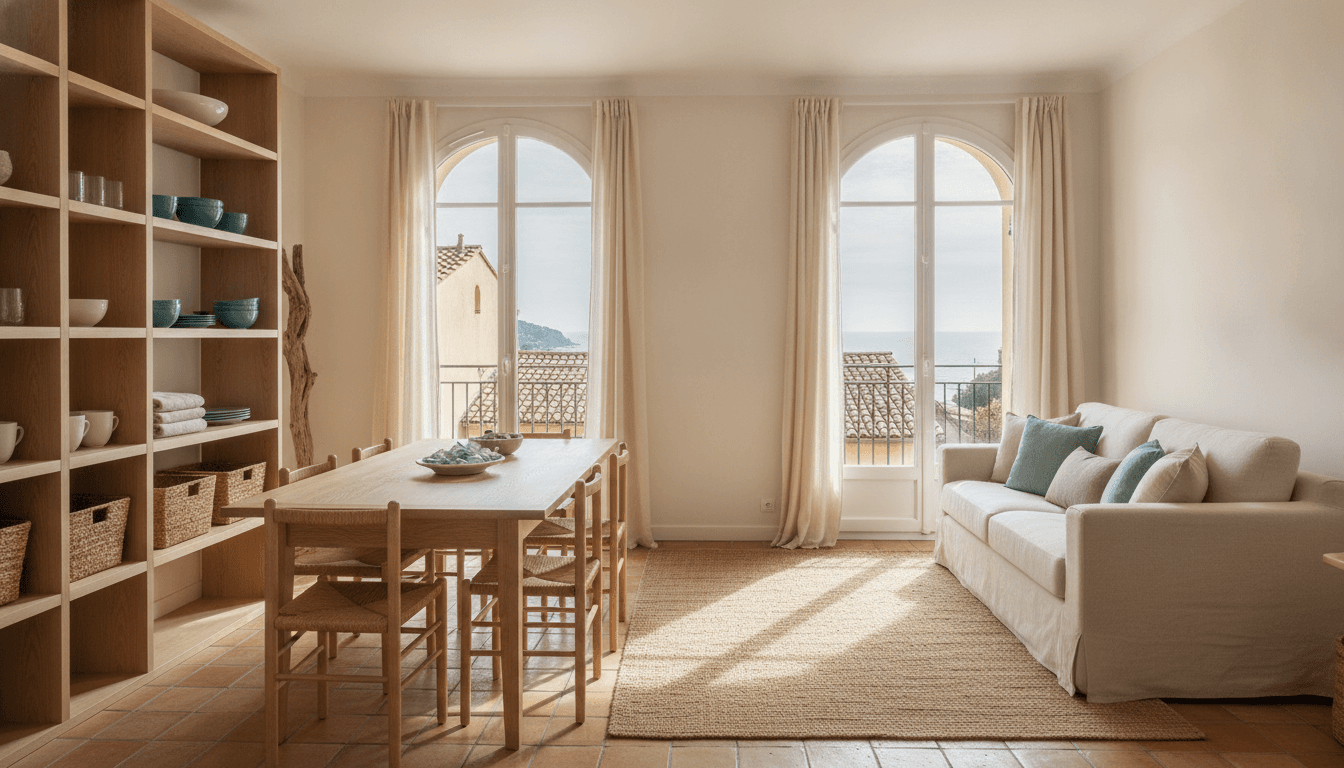
If you live in Italy and are considering Menton, Roquebrune-Cap-Martin, Nice or nearby areas for a short-term rental, the hard part in 2026 is not choosing cushions or writing the listing. It is understanding the French rules early enough to avoid the wrong property, the wrong setup or the wrong timeline.
I wrote this because I keep seeing the same situation. Italy is tightening its own framework for tourist lets, while France is also moving toward closer regulation through the Loi Le Meur, registration changes and local controls. On the French Riviera, where second homes, compact apartments, terraces, strong daylight and salt air all affect how a property performs in daily use, regulation and furnishing need to be thought about together.
Short-term rentals in France: start with the local rule, not the mood board
Many Italian buyers begin with the pleasant part: the view, the terrace, the location near the sea. I understand that. But for short-term rentals in France, the first useful question is administrative.
Before you think about furniture, check these points:
- Will the property be your main home in France or a second home?
- Does the municipality require a declaration, a registration number or a specific process?
- Is the flat in an area where change of use is tightly controlled?
- Are you aiming for an unclassified furnished rental or a meublé de tourisme with official classification?
This matters because France does not work as one single short-let market. National rules exist, but cities still shape the practical reality. Nice is stricter than many nearby towns. Menton and Roquebrune-Cap-Martin also need to be checked locally rather than assumed from what happens elsewhere.
For an Italian owner, that is usually the first trap. A property may look ideal on a portal and still be awkward to operate depending on its exact status and address.
Loi Le Meur explained for Italian owners looking at the French Riviera
The Loi Le Meur is often discussed in fragments, which makes it sound more confusing than it is. In plain terms, it signals that short-term rentals remain possible in France, but under closer supervision, with more structured registration and with strong room for local authorities to tighten their own framework.
Three practical consequences stand out.
Registration is becoming central
The wider national registration framework expected by May 2026 means owners should treat registration as part of the project from the beginning, not as a final formality. If you are buying from Italy, build time for this into your planning.
Municipal rules still matter a great deal
Nice is the clearest example on the French Riviera. The city has local restrictions, and for some properties there are tighter conditions around change of use. In some districts, authorisation requests are also managed within a defined local calendar. That changes how you evaluate an investment. A good address for resale or personal holidays is not automatically a simple address for a tourist let.
The legal status of the property comes before the furnishing scheme
I work in interior decoration, home staging and turnkey furnishing, so naturally I care about the setup of the flat. Still, I would rather say this plainly: the legal frame comes first. If the intended use is not clear, no furnishing plan can fix that later.
DPE and the 2026 calendar: why energy performance now belongs in your rental checklist
The DPE can seem like a long-term rental topic, but that is too narrow a view. As regulation tightens, energy performance becomes part of risk assessment for owners looking at short-term rentals in France as well.
On the French Riviera, this is especially relevant because many attractive properties are older apartments. They may have charm, sea views and good locations, but also dated windows, limited ventilation, heavy summer sun and occasional humidity issues. In small coastal flats, those details affect both comfort and upkeep.
I do not carry out renovation, building work or architecture. That is outside my scope. What I do, at Marea Studio, is look at how a furnished property will live day to day within those constraints. Near the sea, materials matter. Storage needs airflow. Metal finishes age differently in salt air. Thick fabrics can hold moisture. Terrace furniture has to cope with sun and exposure without making a small footprint feel crowded.
That is why I always suggest looking at DPE and general building condition before the furnishing phase is mapped out in detail. It helps owners make calmer decisions.
Why furnishing plays a real role in classement meublé de tourisme
For Italian owners, official classification often comes up as a fiscal or administrative topic. It is that, but it also has a very practical side. Classification is tied to the way a furnished rental is equipped, read and used.
That means the furnishing scheme matters in concrete ways.
I often see two opposite mistakes. One is buying everything too quickly, remotely, with no real response to the plan of the apartment. The other is focusing on decorative image while neglecting use. A Riviera short-let needs to photograph well, of course, but it also needs clear circulation, durable materials, a proper dining setup, sensible storage, blackout solutions and a terrace that feels usable rather than overfilled.
In a small flat in Menton or Roquebrune-Cap-Martin, that usually means:
- choosing washable fabrics that cope better with sea air and turnover;
- keeping furniture proportions tight in narrow rooms;
- making sure evening lighting is warm and functional, not left to one ceiling point;
- treating the terrace as an extension of the flat rather than a storage zone;
- adding practical entry storage for short stays;
- avoiding fragile finishes that age badly under humidity and sun.
This is exactly the kind of work I do at Marea Studio through interior decoration and turnkey furnishing. My role here is straightforward: I help owners create a furnished rental that makes sense in use, not only in photos. If you want to see how I describe that work, you can find it here: /en/services.
Nice, Menton and Roquebrune-Cap-Martin are not the same decision
Owners often compare these locations as if the same setup would work everywhere. On the ground, the differences are sharper.
Nice demands more attention to local regulation, especially for properties that are not a main residence and in districts where authorisations are more tightly managed. Menton attracts many cross-border owners and guests, which often shifts the furnishing brief toward compact comfort, easy upkeep and flexible stays. Roquebrune-Cap-Martin often brings practical constraints that matter more than they first appear: hillside access, building layouts, narrow rooms, strong outdoor exposure and terraces that need restraint rather than excess.
If you are comparing providers, I would keep the split clear:
- a lawyer or specialist adviser for legal status and change-of-use questions;
- the municipality and official sources for procedure;
- an accredited classification body if you want official classement;
- Marea Studio, with my honest bias as a decorator, for layout clarity, furnishing choices, home staging when a property needs to be presented better, and turnkey setup for rental use.
I am not the person to interpret law for you. I am the person who can help make sure that, once the rule is clear, the apartment is furnished in a way that supports the use you actually have in mind.
A simple order of decisions for 2026
If you want one practical takeaway, it is this. For short-term rentals in France, especially on the French Riviera, do not start with style boards or online shopping lists. Start with the town, the district, the status of the property and the likely registration path. Check DPE early. Then build the furnishing plan around climate, maintenance, small-space logic and the quality level you are aiming for.
That may sound less exciting than choosing finishes, but it is the more useful order. In 2026, the projects that feel calm are usually the ones where local rules and furnishing decisions were made in the right sequence.