
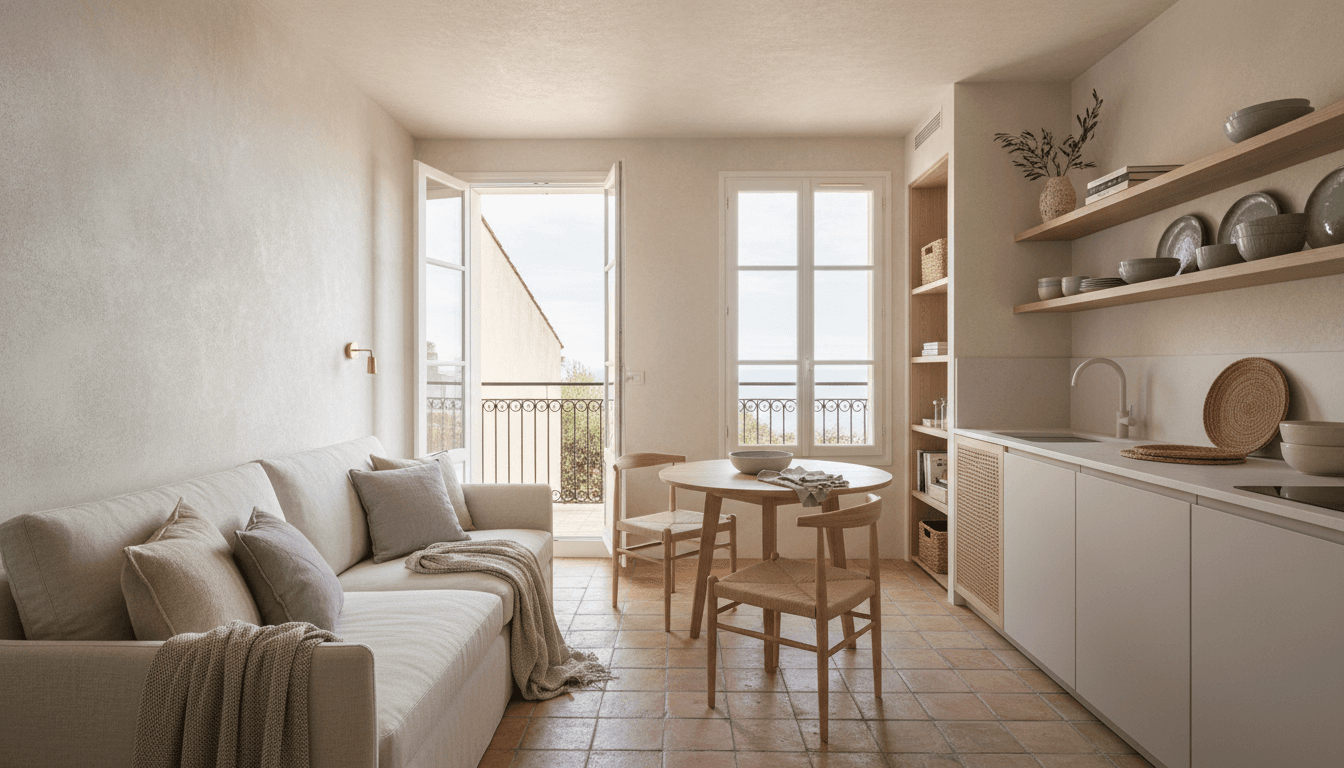
If you are buying a property to rent out, furnishing often becomes the part that drags on. You need the flat ready, coherent in photos, practical for guests or tenants, and durable enough for coastal use. On the French Riviera, turnkey furnishing can solve that, but only if you know the difference between a furniture logistics service and a decorator-led setup designed for a real rental market.
What turnkey furnishing actually includes
The phrase gets used loosely. Sometimes it means a pre-set furniture bundle delivered and assembled. Sometimes it means a fuller service: layout decisions, sourcing, purchasing, delivery coordination, installation, styling, and final setup so the property is ready to market.
At Marea Studio, I use turnkey furnishing in the second sense. I look at the apartment as a rental product with practical constraints. Who is it for. How will it be used. What needs to look good in listing photos. What will wear badly in salt air. Which terrace pieces will survive sun and wind. Where can storage be added without making a small room feel cramped.
That regional context matters. On the French Riviera, many flats are compact, many have outdoor space that photographs well but ages fast, and many owners are dealing with second homes or short-let use. Bright light reveals every mismatch. Humidity and sea air punish weak finishes. A generic setup can work, but it does not always make the best use of the space.
Furniture pack or decorator-designed turnkey furnishing
This is the comparison most investors need.
A generic furniture pack is useful when speed is the priority and the property is straightforward. You get the essentials, usually from a fixed catalogue, with limited design thinking behind proportion, layout or target renter. For some long-let apartments, that may be enough.
A decorator-designed turnkey furnishing service becomes more relevant when the property has friction points: a small studio, an awkward living room, a terrace that should help the listing, a second home moving between personal use and rental use, or a short-let flat competing in a highly visual market.
I want to be transparent and include Marea Studio in that comparison. I am biased toward the decorator-led route because that is the work I do. I do not sell anonymous furniture bundles. I plan the furnishing, choose where the budget matters, source the pieces, coordinate installation, and finish the apartment so it reads clearly from the first photo onward. If you want the most standardised catalogue option possible, there are providers set up for that. If you want an apartment furnished with a clear rental brief and a consistent look, that is where I come in.
How a turnkey furnishing project works in practice
A good process keeps mistakes down and decisions visible.
1. Start with the property, not the shopping list
I begin by reading the flat as it is. Real dimensions, circulation, existing finishes, natural light, terrace exposure, access for deliveries, storage gaps, and the type of rental use planned. A one-bedroom in Menton aimed at medium-term tenants does not need the same setup as a short-let apartment near Monaco.
2. Define the furnishing level
There is a legal minimum for a furnished rental, but the minimum is rarely the right benchmark for marketability. I prioritise the items that affect comfort and clarity first: bed quality, blackout solutions, dining area, sofa proportion, lighting, entry storage, and practical terrace use where relevant.
3. Build a realistic budget structure
Instead of asking only for a total, break the cost into categories: furniture, logistics, and design or styling. That lets you compare like with like. One quote may look cheaper because it leaves out curtains, lamps, kitchen setup, terrace pieces, or installation follow-up.
4. Order, receive, assemble, finish
This is where many owners lose time. Deliveries arrive on different dates. Items are missing. Access windows are tight. Old buildings can complicate transport and assembly. In my work at Marea Studio, I handle the coordination through to final placement, so the apartment is actually ready rather than partly furnished with boxes still in a corner.
What it costs, and how to read the quote properly
There is no serious universal figure for furnishing a rental apartment well. Cost depends on size, number of rooms, intended use, quality level, access constraints, and how much is already in place. A small flat with difficult access can absorb more logistics than people expect. A terrace can add useful value, but also another layer of budget and maintenance choices.
What matters is understanding what the fee covers.
- Furniture and equipment: beds, seating, dining, storage, lighting, textiles, basic decor, terrace pieces if needed.
- Design thinking: layout, scale, material choices, renter profile, photo-readiness.
- Procurement and coordination: sourcing, ordering, tracking, receiving, dealing with substitutions or delays.
- Installation and final setup: assembly, placement, styling, preparing the property for photography or first occupancy.
I find that investors make better decisions when they ask one simple question: am I paying for objects only, or for decisions as well. The answer changes the outcome. A flat can have every required item and still feel unresolved.
What it can return on the French Riviera
It is better to be careful here. Furnishing does not override location, building rules, or local short-let regulation. It can, however, improve how a property is perceived, photographed and used.
According to the research notes provided, furnished rentals generally command a 10% to 20% higher rent than unfurnished ones. The same notes say that careful decoration and professional photos can generate 20% to 40% more bookings for short-term rentals. Those figures are useful as market context, not as a promise.
In practice, the return comes from reducing friction. A room that reads clearly in photos gets understood faster. A terrace with the right scale of furniture feels usable. Durable materials reduce replacement cycles. Good blackout, decent bedside lighting, and sensible storage support reviews and repeatability, even if they are not glamorous purchases.
Regional regulation also affects the equation. In Nice, a main residence is limited to 90 nights per year for short-term letting, secondary homes may require change-of-use authorisation with quotas in certain districts from 1 January 2026, and a registration number is required for furnished tourist rentals in the Nice Côte d’Azur Metropolis. Your building rules matter too, especially if the co-ownership regulations restrict tourist lets. Before choosing furniture, check what rental model is actually allowed.
What I would check before furnishing a rental here
- Co-ownership rules: confirm that the intended rental use is allowed.
- Energy rating: authorisations are increasingly tied to minimum performance levels.
- Outdoor pieces: choose materials that can handle strong sun, wind and salty air.
- Small-floorplate logic: every piece should earn its place.
- Cleaning and replacement: washable textiles, forgiving finishes, simple lampshades, easy-to-source basics.
This is exactly where my work sits at Marea Studio. I do not handle building work, renovation, or architecture. I focus on decoration, furnishing, setup, and the practical decisions that make a rental feel ready and coherent.
If I had to leave you with one plain takeaway, it would be this: a standard pack is fine when your only goal is to equip quickly. If the property needs to compete visually or solve awkward space issues on the French Riviera, decorator-led turnkey furnishing is usually easier to live with and easier to market. If useful, you can see how I approach that on my services page.